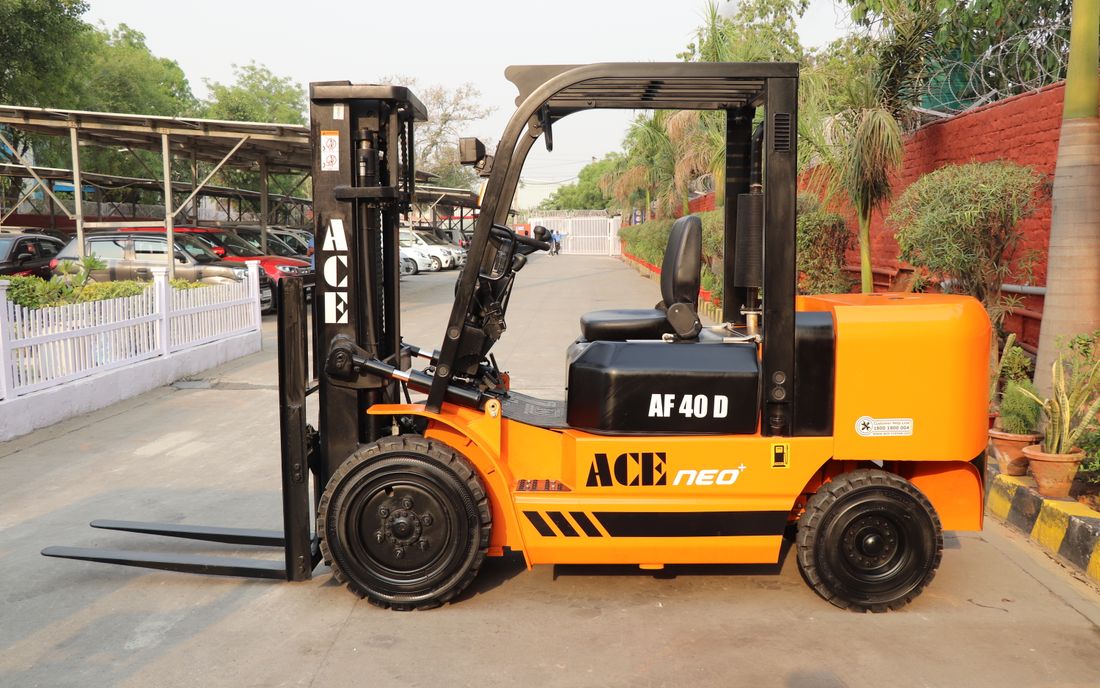
Recording warehouse equipment: racking, forklifts and scales
Racking, forklifts and scales are assets and also the basis of every count. What should be recorded, labelled and checked at regular intervals.
Racking, forklifts and scales stand in the warehouse so matter-of-factly that in the asset register they often appear only as a collective item, such as "warehouse equipment, 1 item". Yet they are doubly important. They are fixed assets and must be traceable in the asset count, and they are the prerequisite of every stock count, because without labelled racks, reliable scales and safe forklifts nothing gets counted. This article shows what should be recorded, labelled and checked at regular intervals.
What belongs in the register
- Racking systems, as one asset per rack installation or per hall, depending on what you agree with accounting.
- Industrial trucks such as forklifts, pallet trucks and lifting platforms.
- Scales of all kinds, from bench scales to pallet scales.
- Conveyor systems, dock levellers and loading-bay equipment.
- Handheld data-capture devices, label printers and charging stations.
- Safety and fire protection equipment, where it is kept as an asset of its own.
How finely the unit of an asset is cut, for example "rack installation, hall 2" instead of "every rack bay", you settle with accounting and the auditor before you order labels.
Not everything has to be kept as an asset of its own. Small parts and low-value items often run as consumables or as a collective item, and the line is drawn by accounting. For the count it is nevertheless useful if such things also have a fixed location: a hand truck that belongs to hall 2 should stand there and not wander between halls.
Recording and labelling
Every asset needs an asset number, a tag on the device, the location with hall and aisle, the serial number, the date of acquisition and a person responsible. The tag always sits in the same place, for example on the left upright for forklifts and on the first post of each installation for racks, clearly visible and not covered. A photo of the rating plate completes the record and makes later searches easier. Choose labels to suit material and location: a paper label will not last long on a forklift that is cleaned every day. In dusty or damp areas robust labels that do not peel off make sense.
Checking regularly and keeping evidence
Warehouse equipment needs maintenance and inspection: forklifts their safety inspection, racking a visual check for damage, scales a check of the display. Which inspections are required at which intervals depends on the equipment and the rules that apply. You clarify this with the responsible body and your occupational safety officer.
For the count it is important that the evidence for each device can be found: last inspection, inspector, next date, in a list or in the equipment log. A forklift without valid evidence does not go into service until the matter is clarified, not even on count day.
Rented equipment and third-party property
Rented or leased forklifts do not automatically belong to your own fixed assets, but they stand in the warehouse and are recorded. List them in the register separately as third-party property, with contract number and return date. How they are to be treated in the accounts is for accounting to settle with the tax adviser.
A walk-round as an example (illustrative)
The register of one hall contains 6 rack installations, 3 forklifts, 3 scales and 12 handheld scanners, 24 assets in all. In addition there is a rented forklift as third-party property, so 25 devices are expected. On the walk-round 23 of the 24 assets are found, and the rented forklift too, 24 out of 25 in all. One handheld scanner is missing and is cleared in the missing-asset list with the usual search steps. On two forklifts the tag is damaged: the numbers are completed from the rating plates and new tags are ordered. The findings of the walk-round go into the same list as the evidence, so that the register is up to date after the count.
In short
Anyone who records, labels and checks warehouse equipment properly creates the basis for every later count. AuditMaster records fixed assets with inventory tags and labels racks and bins with barcodes, so that every count can build on unambiguous numbers.